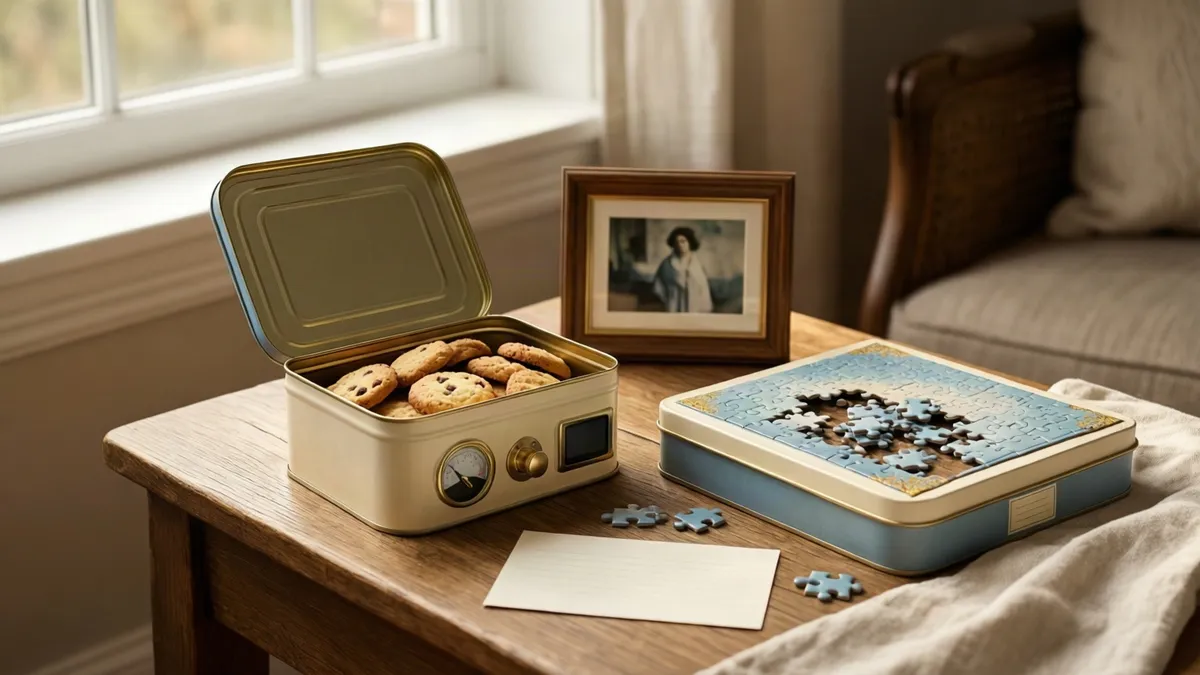
In short: The gift for grandparents who have everything is one that gets used up, gets displayed, or gets done together. Anything else becomes clutter they have to find room for. This guide sorts options into those three buckets, names what to skip, and gives you a price-split rule for siblings.
These are buying guides, not product reviews: we have not used every item on this page. Specs, prices and delivery estimates come from the manufacturer or listing, and whatever Amazon shows when you click is the authoritative figure.
This article contains affiliate links. If you buy through one, we earn a small commission at no extra cost to you. We only recommend what we would suggest to a friend.
The Federal Trade Commission's endorsement guides, 16 CFR Part 255, require a disclosure like that one to be difficult to miss, so it sits above every link here. Our full affiliate disclosure has the rest.
"Who has everything" is really "where does it live." Their closets are full. Their walls are spoken for. The kitchen has what it needs.
If you are buying for the pair, start with our guide to gifts for grandparents from the whole family. The first question is whether this is one shared gift or two. Then run the three-job test.
Start with the rule: use it up, show it off, or do it together
Every gift does one of three things. It gets used up, it gets displayed, or it gets done together. If it does none of those, it needs a shelf, and they do not have a shelf to spare.
That is the whole test. A tin of shortbread gets used up. Framed prints earn a wall. Saturday afternoons together are the gift itself. A throw blanket does none of the three and will end up folded over a chair they already have a blanket on.
The rule settles the format question before you open a shopping tab. You are not choosing a product. You are choosing which job this gift does, then picking the thing that does it best.
Our suggested three-job checklist. Copy this before you shop:
- Does it get used up before your next visit? - Does it earn a spot on a wall or shelf they have already named? - Does it create an occasion you would both attend? - If none of the above, put it back.
Use it up: gifts that disappear gracefully
Consumables are the easiest category to get right. Food gets eaten, flowers fade, bird seed empties. Nothing to store, nothing to dust, nothing that becomes a second job.
A gourmet food basket works when it matches what they actually eat. Skip the tower of processed cheese and find one built around fruit, nuts, or tea. The listing states what is inside, so read the contents before you commit.
For long-distance gifting, fresh flower delivery sends a visible reminder that arrives on a specific day. A bird seed gift suits someone who watches the feeder from the kitchen window and would rather feed the cardinals than get a plaque about them.
Restaurant gift cards are a consumable too, if they treat them as a reason to go out. The Consumer Financial Protection Bureau stated in 2012 that a gift card cannot be sold if it expires in fewer than five years. Additionally, inactivity fees are barred for the first 12 months. That makes a restaurant card a safe bet: it will still be valid when they get around to using it.
Show it off: gifts that earn a wall or a shelf
Before you choose the product, name the wall. If nobody in the family can say where the framed print is going to hang, the calendar is the better gift, because the kitchen already has a nail in it.
Format before product, room before object. Our guide to photo gifts for grandparents walks through the formats in detail. The short version: a digital photo frame sits on a side table and cycles images you email to it. A custom photo calendar hangs where the old one hung. A personalized photo book lives on the coffee table and gets picked up.
A custom house or pet portrait turns a photo into wall art, but only if there is a wall for it. If there is not, it becomes a tube in a closet. Framed prints of any kind need a destination, not just a frame.
Digital frames solve the wall problem by living on a shelf and updating themselves. The listing states whether it connects over Wi-Fi or needs a memory card loaded by hand. Check that detail before you buy, because the setup difference matters.
For printed gifts, count backward from the occasion. Production takes time the listing states, then shipping takes more. Order a week earlier than the math makes you comfortable with. Our Christmas gifts for grandparents guide has the dated timeline for holiday deadlines.
Do it together: gifts that are really an occasion
An experience is the gift that takes up no space at all. Two tickets, a cooking class, a meal out, an afternoon at the museum. The object is the time, and the time does not need a shelf.
Board games for families and jigsaw puzzles for adults fit here too, because the gift is the hour spent playing, not the box. AARP has shown that adults 50 and older say playing board games has social benefits, which is a formal way of saying the table gets louder and that is good.
The trick is choosing something they would actually do together, not something you wish they would. If they do not cook, a cooking class is homework. If they already go to the symphony, two extra tickets are gold.
The comparison table: three ways to spend the same $100
Price bands below are ours, not a sourced figure. The point is not the number. It is seeing what $100 does in each bucket.
| Bucket | Gift at ~$100 | What it does | Where it lives (ours) | How long it lasts | Regift risk (ours) |
|---|---|---|---|---|---|
| Use it up | Gourmet food hamper | Gets eaten, shared, finished | Kitchen counter, then gone | Days to weeks | Low — food is personal but not precious |
| Show it off | Digital photo frame | Cycles family photos on a shelf | Side table or bookshelf | Years | Medium — easy to pass along if unused |
| Do it together | Cooking class for two | Creates one afternoon together | Nowhere — it is an event | One afternoon | Low — an experience is not transferable |
Our take: If the pair shares a kitchen and a calendar, the cooking class is our call. It does the third job cleanly, leaves nothing behind, and the memory outlasts anything you could ship. If they live apart or do not cook, the food hamper is the safer default. The digital frame is the right pick when the family is scattered and photos are the main way everyone stays in each other's view.
What to skip when they already have everything
Blankets. Mugs. Candles. Monogrammed towels. Signs that say "grandparents" in script. Throw pillows, lap blankets, and anything with a handprint pressed into clay.
These fail the three-job test. They do not get used up, they do not earn a wall, and they do not create an occasion. They need a shelf, a hook, or a drawer, and those are already taken.
Slippers and robes are the same problem in a cozy disguise. They already have a pair. If the old ones are worn out, replace them. If not, another pair is a duplicate.
Generic keepsakes are the worst offenders. A plaque that says "best nana" is addressed to a category, not a person. It collects dust until someone feels guilty throwing it away. Skip the memory journal too. It sounds thoughtful, but it is homework. If you want their stories, ask in person and record the conversation.
How much to spend, and how to split it with siblings
For one grandparent, $30 to $75 is the range where you can buy well without overspending. For the pair, $50 to $150 covers most of what this guide recommends. If siblings are chipping in, the share per person should be low enough that saying yes is easy.
The coordination rule is simple. One organizer, one number, one deadline, agreed before anyone is asked. Tell people the amount rather than asking what they can do, and let anyone pay nothing and still sign the card. Our guide to one gift from all the grandchildren has the full mechanics.
The financial picture matters more than you might think. The U.S. Census Bureau reported in 2024 that about 6.7 million people, or 3.3% of adults age 30 and over, lived with their grandchildren in 2021. Of those grandparents living with grandchildren under 18, roughly 32.7% were responsible for their care.
That changes the math. A grandparent raising a grandchild may need practical help, not a hamper. The Social Security Administration maintains a page for parents and guardians outlining benefits that may apply. If that is your family, a gift card to the grocery store they use is not impersonal. It is the most useful thing you can give.
When you don't know their hobbies or their limits
Not knowing their hobbies is normal. You are not failing. The three-job test works precisely because it does not require you to know whether they garden, bird-watch, or collect anything.
Safe defaults by bucket: a food gift they will eat, a photo gift featuring people they love, and a meal out or a game you play together. None of those requires knowing a hobby.
Health and ability change the calculation. For someone with dementia, a digital frame with too many photos can be overstimulating. A few framed prints of people they know, placed where they sit, may work better. For limited mobility, choose gifts that come to them: delivery, not an outing that requires stairs or a long walk.
Shipping restrictions matter for wine, food baskets with perishables, and anything crossing state lines. Check the listing before you commit. Some states block wine entirely. Some perishables cannot ship in summer heat.
For grandfathers specifically, the three-job test still applies. Food, a framed photo, and an afternoon doing something together all work. The difference is tone, not category. A gourmet food basket built around nuts, jerky, or coffee hits the same note for him as for her.
One safety note. The Federal Trade Commission found in 2018 that people 70 and over sent cash about 25% of the time in family and friend imposter scams. The scammer posed as a grandchild roughly 70% of the time. Median losses for those who sent cash reached $9,000. If you are sending a gift card or money, make sure they know it is coming, and verify any request that claims to be from a grandchild in trouble.
The FTC also noted that aggregate losses to family and friend imposters reached $41 million in 2018, up from $26 million the year before. The median loss across all fraud types was $462. The gap between those numbers tells you the scam is both widespread and individually costly. Our guide to birthday gifts for grandparents covers the basics of choosing well for the person, not just the occasion.
How much should I spend on a gift for grandparents who have everything?
Spend $30 to $75 for one grandparent and $50 to $150 for the pair. If siblings are splitting, set the per-person share at $15 to $25 so saying yes is easy. A $35 food basket that gets eaten beats a $75 throw blanket that gets folded over a chair, because the three-job test matters more than the dollar amount.
What if I don't know my grandparents' hobbies or interests?
Pick from the safe defaults: food they will eat, a photo gift of people they love, or an outing you do together. None of those requires knowing a hobby. If you can name one thing they do on a Saturday morning, buy something that feeds that activity. Buy coffee for the early riser or a puzzle for the table they already sit at.
What gifts are safe for grandparents with dementia or limited mobility?
For dementia, fewer photos in fixed frames work better than a cycling digital frame, which can confuse. For mobility limits, choose delivery over outings: flowers, a food basket, a photo book mailed to the house. Skip anything that requires setup, small buttons, or a Wi-Fi password they do not have.
Can I ship a gift to grandparents in another country?
Check the listing's shipping restrictions before you commit. Wine, perishable food, and some electronics face state or international shipping blocks. A digital gift card to a restaurant or retailer in their country avoids the customs problem entirely and still does the "use it up" job.
What do grandparents actually say they want most?
No survey in our sources asked grandparents directly what they want. What the three-job test settles is the opposite question: what will they not have to store? A gift that gets used up, displayed, or done together never becomes a burden, and that is the preference the test is built on.
Which gifts are least likely to be regifted or returned?
Consumables and experiences. Food gets eaten. A class gets attended. Neither sits in a closet waiting for a recipient. Display gifts carry slightly more regift risk, because they depend on wall space the giver cannot see.
What are good gift ideas for grandfathers who have everything?
The three-job test does not change for grandfathers. A food basket built around dark chocolate, smoked salmon, or specialty coffee gets used up. A framed photo of a fishing trip earns a wall. An afternoon at a ballgame, a car show, or a fishing spot together is the gift of time. The category stays the same. The examples shift.
Written by the editorial team behind this site — gift researchers who compile buying guides from public sources, manufacturer specs, and customer reviews rather than hands-on product testing.
Marisol Adeyemi writes buying guides, not reviews; nothing here was tested by us.
Sources
- U.S. Census Bureau — "Southern States Had Higher Than Average Share of Adults Age 30 and Over Who Lived With Grandchildren in 2021" (https://www.census.gov/library/stories/2024/03/grandparents-living-with-grandchildren.html) "Retrieved 2026-08-24".
- AARP — "Playing Board Games Has Social Benefits, Say Adults 50+" (https://dx.doi.org/10.26419/res.00731.001) "Retrieved 2026-08-24".
- Federal Trade Commission — "New twist to grandparent scam: mail cash" (https://www.ftc.gov/news-events/data-visualizations/data-spotlight/2018/12/new-twist-grandparent-scam-mail-cash) "Retrieved 2026-08-24".
- Consumer Financial Protection Bureau — "Giving or receiving gift cards? Know the terms and avoid surprises" (https://www.consumerfinance.gov/archive/blog/giving-or-receiving-gift-cards-know-the-terms-and-avoid-surprises/) "Retrieved 2026-08-24".
- Social Security Administration — "Parents and Guardians" (https://www.ssa.gov/people/parents/) "Retrieved 2026-08-24".
- Federal Trade Commission — "Guides Concerning the Use of Endorsements and Testimonials in Advertising" (https://www.ftc.gov/legal-library/browse/federal-register-notices/guides-concerning-use-endorsements-testimonials-advertising) "Retrieved 2026-08-24".